


Written by Jade Conner
There was a window in the early 2010s where it felt like you could slap a subscription onto anything and suddenly a boring, old industry had new life. Movies became Netflix. Songs became Spotify. Groceries became HelloFresh. The logic was simple: one sale is a transaction, but a subscription is recurring revenue. Investors love recurring revenue because it is both predictable and scalable, which means these businesses are more likely to receive funding and at higher premiums.
The idea of transforming the fitness category into a recurring fee model felt not only rational but inevitable. And thus, ClassPass was born.
Origins
ClassPass, like many great businesses, was born out of frustration. Founder Payal Kadakia, a dancer and former Bain consultant, was tired of hunting for classes online. So, in 2013, she launched Classtivity (rebranded to ClassPass in 2014) - a discovery tool for fitness classes. You could type in the type of activity you wanted to do, and it would show you a map of options across your city.
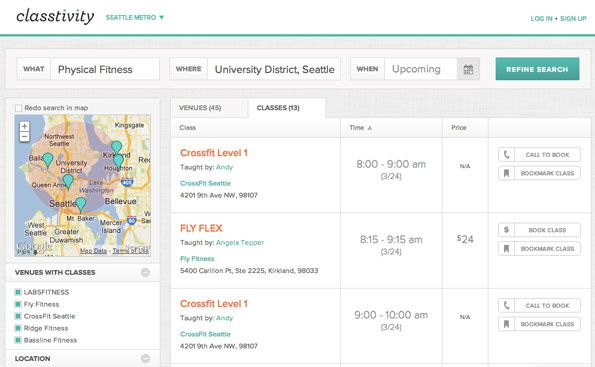
On paper, it solved the problem of fragmented information but in practice, it didn’t solve the bigger problem, which is that most people are allergic to micro-decisions. You don’t just want to be shown a map of options, you want to be able to book them on the website too.
So Payal pivoted.
Scrapping the original business model, she rebuilt around a much larger idea: removing the friction of trying something new and bundling that into a single membership that gave users the ability to hop from studio to studio.
It was smart arbitrage opportunity : studios had off-peak empty spots – 6 a.m. yoga, 11 a.m. HIIT, mid-afternoon barre when everyone else was chained to their desks – and those spots were worth essentially nothing once the class started. ClassPass negotiated access to that “perishable inventory” at a fraction of the retail price and wrapped it in a subscription that translated into predictable recurring revenue on their side and psychological freedom on the consumer side.
Peaks and pits
ClassPass exploded. Users believed they were hacking the system – accessing $35 classes for the price of coffee – and studios believed they were filling empty spots that would otherwise go unused. Consumers got variety, studios got incremental revenue, and ClassPass sat in the middle, quietly printing demand-side arbitrage.
But almost every “win-win” marketplace has a hidden loser, and in this case, it was the underlying unit economics. The unlimited $99/month plan, which became a minor cultural phenomenon in big cities, was a car crash in slow motion. Super-users abused their ClassPass membership, stacking two workouts a day, and the more value they extracted, the worse the unit economics became.
The company tried to fix this by layering on complexity and introducing friction. Unlimited memberships gave way to capped plans. Capped plans gave way to credit systems. Credits became dynamic pricing. Suddenly every class had a different “value,” and the once-clear proposition collapsed into mental math: how many credits do I have, how many will this cost today, and is the algorithm going to punish me for liking this instructor too much?
The logic from HQ’s perspective was clear enough – if some studios were being overused and others underused, dynamic pricing could nudge behaviour and protect margins – but every one of those tweaks made the product feel slightly worse for users and slightly more precarious for studios.
Marketplaces only work when everyone wins. Nick Sleep calls it “scale economics shared”, which is the idea that a company uses its growing scale to give more back to customers - usually through lower prices - to win long-term loyalty. Amazon and Costco are prime examples of this.
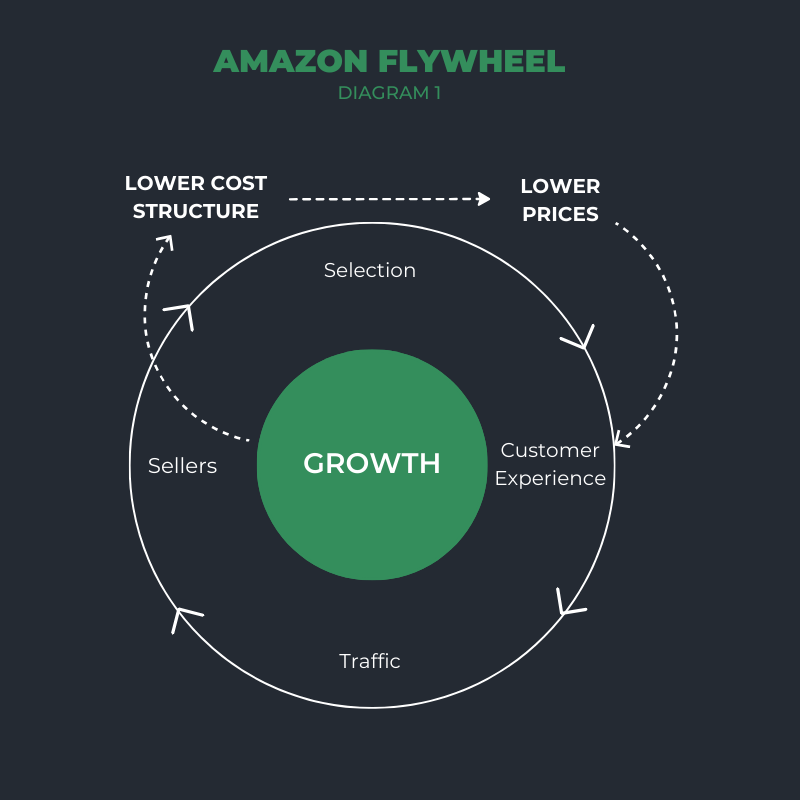
Unfortunately, ClassPass went the other way. It squeezed the very people who made the platform valuable.
When a platform keeps more for itself and gives less to its ecosystem, the flywheel slows, and that is exactly what happened.
COVID & the exit
ClassPass’ model depends on three things: studios being open, consumers showing up, and a large enough pool of participating venues that make the subscription feel abundant with options. COVID took all three out in one go.
Whatever loyalty existed to the ClassPass brand evaporated even faster than loyalty to individual studios, because they never built a durable moat of its own: no switching costs, no network effect strong enough to defend, no counter-positioning, no brand power that lived outside the studios themselves. Aggregation only works when you have supply and demand.
Digital fitness got dramatically better at the same time. Peloton turned living rooms into studios. Apple Fitness+ rode along in your pocket. People evolved.
In January 2020, ClassPass raised $285 million in funding at a $1 billion valuation, and in October 2021, was acquired by Mindbody in an all-stock deal.
Why the Model Stopped Working
Supply side
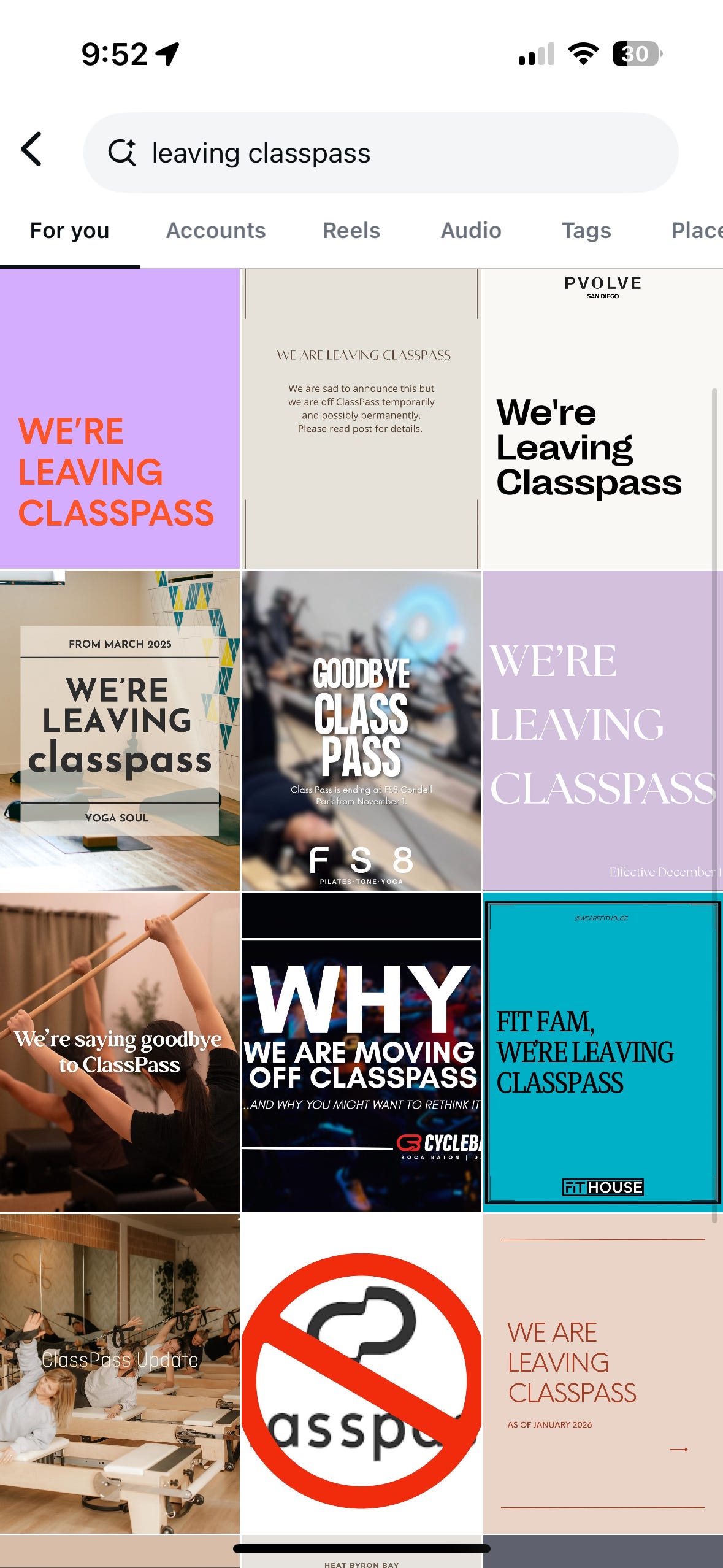
The first big problem was that studio owners started to pull away. They started comparing notes on what ClassPass paid them per visit, how those payouts had changed over time, how many of their once-loyal members had migrated onto the platform simply because it was cheaper. Clearly, they did not like what they found.
Some studios reported being automatically enrolled into “first class free” programs without their consent - meaning they earned nothing for those classes while ClassPass still collected subscription revenue. Studios carried the full cost of delivery: instructor pay, front-of-house staff, rent, electricity, amenities.
Others noticed ClassPass listing their classes at prices far below sustainable levels, often paying out less than half of their direct rates. Long-time members would cancel their studio memberships and rejoin through ClassPass because it was cheaper. Small studios simply couldn’t compete with a global platform dictating both pricing and visibility.
Studios eventually realised what ClassPass had actually created: a generation of fitness consumers with zero loyalty and infinite choice. A system optimised for variety will never organically create commitment.
The brand relationship moved from “I do yoga at X” to “I found this yoga class on ClassPass,” and that linguistic shift tells you exactly who was gaining power and who was losing it.
As the resentment built, studios did the only thing they could: they left.
And what happens when supply dries up? Demand follows.
Demand side
Early ClassPass felt like standing in a Chanel store with an unlimited credit card.

ClassPass today feels a lot more like admin: “I need to use my credits before they expire.” The mindset shifted from “I get to” to “I have to,” which is one of the steepest behavioural downgrades you can trigger in a consumer product.
Too many credits, too many rules, too many small frictions layered on top of what is, for most normal people, an already fragile habit. Fitness works when it’s simple and emotionally rewarding.
At the same time, culture shifted underneath them. The last few years have seen the rise of ritual and routine, to the point of religion. Tracey Anderson is the perfect example of this, with cult-like fans who’ll spend initiation fees upwards of $1,500 and monthly fees of $900 for full membership access. Consistency became more aspirational than discovery, because your workouts became increasingly a part of your identity.
Even within certain aesthetics, like the pilates clean-girl universe, people split into micro-communities. Are you a Lagree girl, a hot-mat loyalist, or strictly reformer?
To an outsider the differences are negligible, but within the culture they operate as taste markers and identity cues.
ClassPass was optimised for variety seekers at the exact moment the most culturally influential pockets of the market became ritual seekers.
Business Model as Feature vs. Business Model as Tax
Before getting into growth ideas, I think ClassPass needs to be run through a simple diagnostic: does the business model make the product experience better, or is it just financial engineering?
This is a mental model I learned from Kirsten Green on The Generalist.
Every great consumer company passes this test.
A great example is Spotify – its subscription model isn’t just about creating revenue predictability; it fundamentally improves the experience by removing ads and enabling offline listening. Compare that to many other subscription-based consumer companies, where the model is in place primarily to benefit the company, not the customer.
- Kirsten Green
ClassPass is the bad consumer company in the above example. It’s credits, caps, and dynamic pricing don’t enhance the fitness experience; they complicate it.
All the issues with ClassPass ultimately collapse into two simple truths:
Users don’t feel like they’re getting a good deal.
Studios don’t feel like they’re getting a good deal.
The business model must move from extraction to shared upside. The incentives should be rewritten so that what’s good for the user is also good for the studio, and therefore good for ClassPass.
So how do we do this?
If I was the Head of Growth for ClassPass, here is where I would start:
1. Fix the pricing model to rebuild trust with studios and users
Back to basics.
The key problem here is the business model does not work. Every evolution of the business model - credits, dynamic pricing, caps - slowly made the product experience worse. Right now, the economics actively make the product feel more confusing, less intuitive, and less rewarding.
If I was head of growth at ClassPass, my first move would be clarity. When users and studios sign up, they should know how much value they are getting out of this, without needing to open a calculator.
The credit system and dynamic pricing does not work. ClassPass should think about experimenting, something that I would pay for would be a “Routine” option:
Users pay a flat monthly fee for a fixed number of classes at three chosen studios
Studios receive a fixed per-class payout to fill empty spots, creating a “fractional” membership where they can access contract-like revenue, with a higher likelihood of conversion
ClassPass should revenue share if a user converts for the first 3/6 months of the user’s membership, ensuring incentives are aligned
Simplicity is a growth lever here.
I’m not sure if they already do this, but ClassPass should lean into the data they hold and help owners understand who’s coming in, what patterns they follow, which classes drive repeat visits, how their performance compares to similar studios in other cities. Make ClassPass not just a source of customers, but a source of insight they couldn’t get themselves.
2. Make bookings better
Once users know the value of their subscription, I would then focus on making booking easier.
Smarter recommendations come from abandoning radius-based feeds and actually building taste intelligence. This means learning from behaviour the way Spotify or TikTok do: map a user’s “fitness fingerprint,” cluster them with similar users, and recommend studios, instructors, and class types based on pattern recognition rather than proximity. If someone consistently books early-morning pilates with female instructors in two neighbourhoods, the app should know that. If I only book pilates classes, please don’t show me boxing. I can search it if I need.
3. Gamify progress
Fitness is story. Strava is a $2.2 billion company built on that idea.

People stick with routines when they can see who they’re becoming. Strava nailed this by turning workouts into social proof - shareable maps, stats, achievements - and then layering on the simplest, most addictive mechanic of all: kudos. A run isn’t just logged; it’s applauded. That peer affirmation is massively dopamine-inducing, and it keeps people coming back because progress feels public, witnessed, and celebrated.
ClassPass should lean into this and build visualisation tools that turn behaviour into a story - streaks (the same way an Apple Watch does it), Instagram templates, favourite studios, instructor loyalty, time-of-day patterns, new activities tried, personal records. Package it like the fitness version of Spotify Wrapped. People love data that tells them more about themselves, especially when they can share it.
4. Focus on the core product
You should not be able to buy a coffee or avocado toast with your ClassPass credits.
You should not be able to book a nail appointment with your credits either. In my opinion, these add-ons don’t enhance the fitness experience; they dilute it.
This kind of horizontal expansion reflects a platform trying to grow outward before it has earned the right to. When the core product is already strained, branching into adjacent categories complicates the user journey and distracts from the fundamental job the product is meant to do: make fitness easier, more consistent, and more rewarding.
You cannot afford to lose focus when the core product is not working.
5. Become culturally relevant again
Finally, ClassPass needs to be cool again, because right now the brand mostly shows up in complaint threads on Reddit and TikTok.
Something I have been observing is a shift in how we travel.
People are less interested in the tourist attractions, rather there is a bigger focus on “trying on” a city for a day. They want to live like a local, eat where locals eat, drink where locals drink, and sweat where locals sweat.
ClassPass should lean into this, becoming the go-to provider for travellers. When you visit the boxing gym in London, or the reformer studio in NYC, you explore new neighbourhoods and make friends.
At home, the promise of endless choice works against the desire for ritual. When you’re travelling, it’s a way to find routine or familiarity in a new city, and I think ClassPass should turn that into a signature use case.
The Rolodex Takeaway
ClassPass invented the fitness subscription model and proved that people would absolutely pay to live inside a network of experiences instead of being tethered to one.
But the next chapter requires a different kind of imagination - one that tackles the structural imbalance the first model created. ClassPass drove prices down to keep users happy, but that discount had to be paid for by someone, and it was studios footing the bill.
If ClassPass can rebuild trust with studios, simplify the user experience, and reposition itself as the global guide to how modern people move, it might have a real chance at turning this sinking ship back around.
The demand for great fitness experiences is still there. It’s just waiting for a platform worthy of becoming a habit again.
Every time I read these I feel so privileged to be getting these insights! Topics feel so relevant to days consumers, always think your take on what you would do are rich and different and not basic ! Thanks for another great read x
I’m a recent ClassPass user, and I agree with all of this! I love your ideas for growth, and the reason I put off being a member for so long was exactly as you stated: confusion. I also love the idea for a data hub for studios! A wonderful read!